







Carnival of Oruro: Living Heritage of Dance and Devotion
Blending Indigenous traditions with Catholic devotion, the Carnival of Oruro stands as one of Latin America’s most powerful cultural expressions.
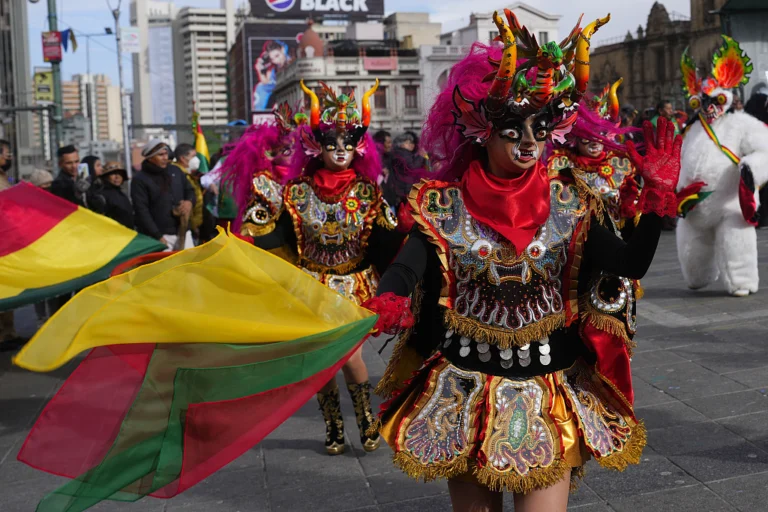
Dancers perform the Diablada during the Carnival of Oruro, where Andean cosmology and Catholic devotion converge. Photo: @cgtnenespanol
August 18, 2025 Hour: 7:07 am
🔗 Comparte este artículo
Every year in the Bolivian mining city of Oruro, tens of thousands of dancers, musicians, and devotees take to the streets in a ritual that unites ancestral Andean beliefs with Catholic symbols. Declared by UNESCO a Masterpiece of the Oral and Intangible Heritage of Humanity, the Carnival of Oruro remains a cornerstone of Bolivia’s cultural identity.
The festival traces its roots to pre-Hispanic rituals honoring the Pachamama (Mother Earth) and the apus (spirits of the mountains). With the arrival of Spanish colonization, these traditions were reinterpreted through Catholic devotion to the Virgin of Socavón, whose shrine stands at the entrance of an old mine.
At the center of the celebration is the Diablada, or Dance of the Devils, a theatrical performance depicting the struggle between good and evil. Elaborate masks, ornate costumes, and complex choreography merge Andean mythology with Catholic narratives. Other emblematic dances add layers of meaning: the Morenada recalls the history of African slavery; the Tinku reenacts ancestral warrior rituals; and the Caporales, created in the 1970s, transform the figure of the colonial overseer into popular dance.
Over three days, more than 60,000 dancers and 15,000 musicians join a pilgrimage that stretches nearly four kilometers and can last up to 20 hours. Each fraternidad—dance groups that rehearse all year—parades in hand-embroidered costumes and artisan-made masks, many featuring figures such as serpents, toads, and condors, each with symbolic weight in the Andean worldview.
The procession culminates at the Shrine of the Virgin of Socavón, where performers make offerings that combine Catholic prayers with Andean rituals of gratitude. This fusion of the sacred and the celebratory is what makes Oruro’s carnival unique in Latin America.
The city’s mining history is also inseparable from the festival. Known as Bolivia’s “folkloric capital,” Oruro has long been shaped by tin and silver extraction. The devotion to the Virgin of Socavón arose as spiritual protection for miners working underground, and that bond continues to anchor the celebration today.
More than a spectacle for outsiders, the Carnival of Oruro is a living tradition sustained by the communities that create and renew it every year. In its music, masks, and faith lies a legacy that not only preserves the past but affirms an enduring identity that projects Bolivia’s culture to the world.
Author: MK